How are embryos protected and selected in the IVF lab? Inside RSC’s labs
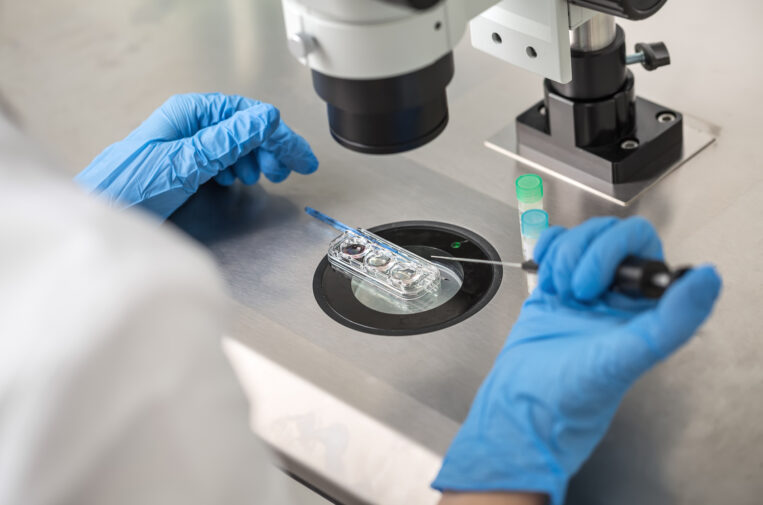
Your eggs, sperm, and embryos spend some of the most important hours of in vitro fertilization (IVF) in our embryology and andrology labs, and you’ll rarely see it. Here’s what happens behind the scenes at Reproductive Science Center of the San Francisco Bay Area (RSC), where we’ve been helping families grow since 1983.
Our IVF labs in San Ramon and Menlo Park serve patients across the Bay Area.
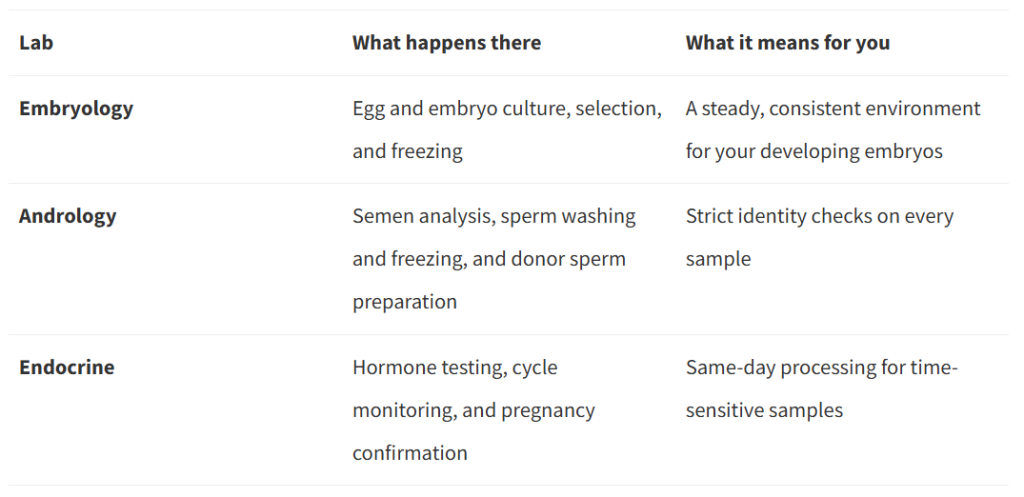
1. Three specialized labs, one standard of care
A full-service fertility practice relies on more than one lab. We run three specialized labs, and all three operate under some of the most rigorous, verified protocols in the field.
2. Identity checks at every stage
A strong lab verifies the identity of every specimen at every step. Every specimen in our care moves through a chain-of-custody protocol built on both human and electronic verification, and its identity is confirmed at each stage.
You’re part of the process too. At key points, you’ll confirm your identity out loud, and we’ll verify it with your photo, a wristband, and barcode scanning.
3. Electronic witnessing that tracks every step
Human checks work best alongside electronic ones. Our electronic witnessing system creates a time-stamped log of each step and alerts the embryologist to any inconsistency before a mismatch can occur.
4. Carefully controlled air quality
Embryo development is sensitive to its surroundings, and research has linked poor air quality in IVF labs with lower fertilization and embryo development rates.
Our IVF labs use HEPA-filtered air systems that control both airborne particles and gases known as volatile organic compounds (VOCs). Humidity is held at precise levels throughout the lab, too.
5. Advanced incubators and closely monitored storage
Your embryos develop in advanced incubators that keep their environment stable while they grow.
When embryos, eggs, or sperm are frozen, they’re stored in tanks with multiple systems that monitor temperature and integrity.
6. AI-assisted embryo selection
Choosing which embryo to transfer is one of the most important decisions in an IVF cycle. Embryologists traditionally make that call by assessing embryos under the microscope, and even among highly experienced embryologists, some variability is expected.
RSC was the first clinic in the U.S. to offer Embryo Predict™ by Alife Health as part of routine IVF care. It’s the first IVF artificial intelligence (AI) tool cleared by the U.S. Food and Drug Administration (FDA).
Embryo Predict analyzes images of Day 5, 6, and 7 blastocysts that your embryology team has already identified as candidates for transfer, then generates a data-driven score. That score gives our embryologists a consistent, objective reference point when choosing an embryo. The tool supports our embryologists’ expertise; it doesn’t replace it.
AI-assisted embryo selection is optional. You and your physician can decide together whether it’s right for your cycle.
Learn About AI Embryo Selection
7. Accreditation and public outcome reporting
Ask whether a lab is accredited and whether the practice reports its results. Our labs are accredited by The Joint Commission, an independent, nonprofit organization whose accreditation is recognized nationwide as a mark of quality.
Our embryology labs also meet the stringent criteria required for membership in the Society for Assisted Reproductive Technology (SART), the organization that sets standards for assisted reproductive technology (ART) care in the U.S. We report birth outcome data to SART every year, so our results are available for anyone to review.
8. Embryologists with years of training
Embryology is highly specialized work. Our embryologists complete a 4- to 5-year training pathway of mentorship and supervised practice before they perform procedures on their own. Their competency is verified every year, and data-driven quality assurance checks run daily.
Our IVF labs are led by Oleksii Barash, Ph.D., HCLD, IVF Laboratory Director.
9. Research that moves fertility care forward
Practices that contribute to research tend to stay close to the latest evidence. Every year, our physicians and scientists contribute research to the American Society for Reproductive Medicine (ASRM) annual meeting and publish in leading journals, including Fertility and Sterility and Human Reproduction.
Our clinical and embryology teams also took part in the large, prospective, multi-center randomized controlled trial that led to Embryo Predict’s FDA clearance.
Questions about IVF labs
An IVF lab handles the steps of treatment that happen outside the body: fertilizing eggs, growing embryos, freezing eggs, sperm, and embryos, and preparing embryos for transfer. Many practices also run andrology and endocrine labs for semen analysis, sperm preparation, and hormone testing.
High-quality labs use a chain-of-custody protocol that combines human and electronic checks. At RSC, specimen identity is verified at each stage, patients confirm their identity with photos, wristbands, and barcode scanning, and an electronic witnessing system logs every step.
AI embryo selection uses artificial intelligence to analyze embryo images and generate a score that helps embryologists choose which embryo to transfer. RSC uses Embryo Predict™ by Alife Health, the first FDA-cleared AI tool for IVF.
No. At RSC, AI gives embryologists an additional, data-driven reference point for embryos they’ve already identified as transfer candidates. The final decision stays with your embryology and care team.
Look for lab accreditation from an independent organization, such as The Joint Commission, and SART membership for the embryology lab. SART members report their outcomes every year, which lets you review a practice’s results.
See the labs behind your care
Want to learn more about our labs or talk with a fertility specialist? If you’ve heard about insurance coverage for fertility coming to California, we bet you have questions. Our team can help you understand your benefits.
Call 1-888-377-4483 or request an appointment online.